Technology to Create Storyboards

Some Background

This blog talks about integrating a new technology to year 11 computer science subject. Although not a very popular subject in K-12, for Qatar (where I live)  at least, it is extremely interesting. The curriculum teaches computer science concepts through Alice, a 3D drag-and-drop programming environment.

Educational Goal

The lesson plan is designed to teach students how to create storyboards which will later help them to create 3D animation of it. You car read the lesson plan here

Technology Tool

For this lesson, students will create their storyboards using Sway.com, a tool that helps users to create and share web content. While it can be argued that PowerPoint can also do the job, Sway has the advantage to easily share a web link then is viewable from any device with no download. Hence students can share their work with more people.

Rational

As Thomas and Brown say that students should know how to get information, this lesson helps them experience learning through feedback from their own network (family and friends). Moreover, as Hobbs speaks about Access Create and Reflect, the lesson plan achieves them through the following ways: using Sway give students the access to a new tool. Moreover it gives them the access to express their stories to the classroom and to the public. Students also practice creating storyboards, where they can integrate images, sounds and texts and share it with real audience. After sharing their work, students are encouraged to reflect on their work when they receive other perspectives.


 

Learning Game Development

Learning can happen in so many ways, the school is a mean for organized structured learning. This blog is a reflection of a learning experience using “Online Network”. That is, only using youtube and online forums, I tried to learn game development. Watch this short video to see how the experience was like.

https://youtu.be/3N_gGrlFUKM

Also play the game here, please wait a few seconds for the game to load!

Cannot play the game? Watch it here:

The experience

I am happy that I have learnt basics of game programming: game physics, player controlling, adding states, etc. Also I learnt of some useful tools such as Phaser, Textile.


My reflection

I think the networked learning is great way when starting to form a new knowledge. Anyone can actually practice a new skill, advance by asking others or check others’ similar questions online. There is a huge world out there and people from all around the world has been sharing their ideas, making free access tutorials, and building forums to create online communities where people really help each other, without knowing who is on the other end. It’s fantastic!

It might not be however the best solely source. The downside might be (when I think of myself at least) when wanting to advance my own knowledge in game development, I need to read news about games and changes that take place in available tools, I also need to understand some fundamentals about new tools that are usually published faster in manuals in case I want to stay on top of the game.

Another challenge is the fact that it is so easy to get distracted when in youtube. Having a clear stated goal is so important to get out with productive time online. I learnt new tactics of self discipline!  

Some resources:

Here are some of the things I needed to learn:

-I leant Phaser (A gaming platform) with this intro

https://www.youtube.com/playlist?list=PLRYUip1E8-a6P0HQpDLn534sLWg1dHaGl

-I needed to know how to randomize falling planets

http://stackoverflow.com/questions/14422233/how-do-you-select-a-random-variable-within-a-function-in-javascript

-Physics

when i needed to check collisions, this video helped me

https://www.youtube.com/watch?v=0bygfvP1rt4

-how to increment score per collision http://stackoverflow.com/questions/30854960/cancel-collision-after-initial-detection-using-phaser-in-js

-How to create and update text object:

https://www.youtube.com/watch?v=XhCEox52gE

Note: some of these links might be challenging. For example, some of the tutorial videos assume background knowledge so you might find yourself confused, but you can always try to dig deeper to understand the skipped steps!

How do I get my stuff DONE?

I recently started using Wunderlist to organize my Professional Development life. The default criteria for today’s applications is the ability to sync across devices. This is checked off in Wunderlist. Plus you can easily share a list with a co-worker via email!

The cool thing about this tool is that it allows you to create lists, so that I can have todo list for long term (e.x. reading list) and short term (e.x. University assignments). Moreover the lists can be organized within folders. So you can have multiple long term lists such as readings and personal development; or for short term goals such as: social media update, course work.
I am one of the people who like to keep a App-per-area. I tend to keep my job todo list on Google Keep. The most simple keeper of ideas, lists, reminder, that is also sync across devices. The interface is extremely intuitive and relaxed. In Keep, you don’t have to think: which category should I open before I add this note? Instead, you can add any note, then just #hashtag it to the corresponding category, so you can easily find it later. It also has a chrome extension, so that whenever you find a nice link you want to save, it can be added to your Keep with a click.

Learning HTML Game coding

I always thought that learning to code games is very exciting! I knew very little about html coding however it seemed to be my best bet for its popularity and abundance of resources. Throughout my learning, I mainly used youtube videos that are made for online courses such as Udacity, Zenva, and CodeYourFirstGame, with the help of StackOverFlow forums.

Hence to use all the various resources in the most efficient way, I broke down of my learning goals was as follows:

  1. Upload a ready game on my site, just to make sure I can publish game files.
  2. Edit user control of the game, to make sure I can handle user interaction.
  3. Code a simple game to understand the main components of any 2D game that is developed using HTML5 with help of this video

    screenshot-2016-09-22-21-30-53
    Coded with help of YouTube
  4. Code my game with more graphics! (this will happen next week)

I felt very accomplished after I completed the first 3 goals. This video shows you a glimpse of the process:

https://www.youtube.com/watch?v=ZyHPUZQ6aFk


However, IT IS NOT AS SIMPLE AS THIS!

Coding a game involves user input, constant window update, physics, and graphics. I was able to learn those gaming concepts through videos, which I felt very similar to attending a classroom lecture (except the fact that you can skip to what interests you!). Yet, since this task only allows me to use YouTube and Help Forums, following a video to code was a little frustrating. Many programmers use from a ready code as a starter, then pick and match different code snippets to build a meaningful program. In this specific task I wrote each bit of code, so the more write, the more natural it became to follow up with videos. Turns out it is not a very bad idea to learn to code with videos! 

Another challenge I faced had to do with the fact that most of the videos available are based on online courses. Hence I missed out on the interactivity benefit of actually taking the course, such as completing assignments, getting to interact with TA’s and classmates, etc. At this point I tried using forums which were a lifesaver to me. I found that many people had previously asked the questions I have in mind. It realised that I was saving time by investing it only on my area of deficiency instead of solving assignments that I might have found super easy or super hard. I was working on my pace basically, much better compared a classroom style. 

In the next week I will use what I learnt in making a game with more graphics, and hopefully with levels (figures crossed) as I will need to learn using more advanced features to create player progress.

Stay tuned!

My Journey in Game Creation

I have been a gamer ever since my childhood (like many millennials!). Gaming was one of the reasons that motivated me to do a computer science degree so that I could one day create some fun games with my own ideas and imagination. During the next 4 weeks I will be learning how to build an online game and publish it here in my blog. There are various free tools to help me build games, which can be played on online, offline, and on smart devices. I am more interested in online game, to ease sharing them. The goal is that the end game is visually appealing, fun for average person (a three year old should enjoy it), and has an exciting ending.

Summing up my goal:

  • Use HTML5 code (no quick drag and drop tool!)
  • Start with a dummy game for testing and upload online
  • Design and develop the last version of my game
  • The game is interactive, i.e. takes in user input
  • My four year old nephew should enjoy it 

To complete this, I am limited to use Youtube and online help forums, yet there is more than enough resources, such as Udacity channel videos. I also have an online page that is not yet public, so I will use it to host my game.

I am so excited! 

Learning to Achieve Understanding

As I am starting my Masters in Educational Technology at MSU, I wrote this essay to reflect upon my understanding on learning, its methods, and how does it apply in my work. I was very excited to learn that many of the educational methods suggested in How People Learn are already practiced in the project I am currently working on. The book is brilliant and I highly recommend it for educators, curriculum designers and decision makers, it is in fact one of the most influential books in education. In this essay I answer to my assignment in CEP810, and talk about how the teaching methods and practices of the book apply to a newly-developed computer science curriculum that I am working on.

Happy reading!

Hanan in Gracehopper

Untitled

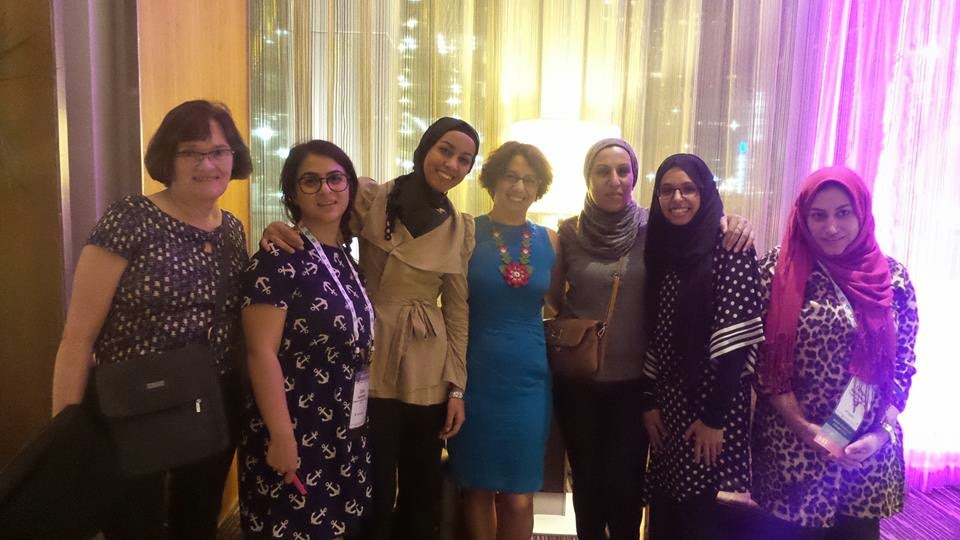
After finishing my undergrad, I came to know about the GHC scholarship offered be Qatar Computing Research Institute (QCRI) in collaboration with Arab Women in Computing (ArabWIC). I applied and luckily got selected with other 6 inspiring ladies, whom I will never forget.

My trip there was a unique one, where I met a new scholar of GHC at every flight stop from Qatar to Arizona. Starting from Doha Airport, I met Fatima Alabdrabalnabi, the Founder of Google Developer Group of Saudi Arabia. And the video of “Geeks under Niqab” maker, which got the recognition of Megan Smith (former VP of Google[x]), who sent her personal invitation to Google I/O. At my second stop at Chicago Airport, I met Samah Kareem, head of ICT at the Palestinian Standard Institution. Other than our duty free shopping at the airport, the three of us bonded so closely.

The best part of the conference was seeing an endless numbers of technical bright ladies, a crowd of 8 thousand participants; some occupies top leading positions in the technical industry and academia. I met the Chief Technology Officer of USA – Megan Smith, the senior data scientist at Twitter – Ayse Naz, the Research Scientist at IBM – Dr. Kaotar El Maghraoui, the Clinical Professor of Computer Science at NYU and founder of Arab Women in Computing – Professor Sana Odeh, and so many more. Seeing all those people at one place was so thrilling.

The conference included a wide variety of lectures, panels, and workshops that find its to benefit you. Starting with a keynote at every morning of the conference was the motivation that kept me energetic till the end of day. Particularly listening to Satya Nadella, CEO of Microsoft, and how valuable to know views on women in technical career. One the most interesting panels I attended was “Real World Data Science at Scale”, a very mind opening to me after I spent at least a year in the Natural Language Processing research. The quality of workshops at the conference were so practical, starring “Winning the game of politics” workshop, which attained so much popularity that the huge hall ran out of space.

Another giant benefit I got from the conference was the career fair. I never have been to a recruiting event where most of the recruiters and engineers were women! Furthermore, I got introduced personally to people from top tech companies, such as: GE, Google and PayPal. Had the chance to ask so many questions about the work nature with such amazing and inspiring professionals. Also I was lucky to get admission fees discounts from some university programs!

To conclude, I forward my gratitude to all who made this experience possible; the optimistic leadership of ArabWIC, the generosity of QCRI funding, the perseverance of Anita Borg Institute of their support to women in tech. If it wasn’t for the great leadership and support I got from ArabWIC, I would not have had that level of enthusiasm and confidence at the conference.

Lastly, this is a call for all ladies in tech to make sure attending GHC, and if you happen to be an Arab, do not miss out and join ArabWIC community!

 10593234_10204742094769191_4324267858137153328_n
ArabWIC starts! The founder Dr. Sana Odeh in middle, wearing blue dress 🙂