A Learner’s Reflection

From the countless conversations we have about our career or passion, a few gets stuck in our heads. An impactful conversation that I still remember to this day is one that I had with my supervisor. We spoke during our last meeting before I left research and went to teach math at a public school. Here is an excerpt of the most conversation that had an everlasting impact on me. This part started after I complained about the education system where I live:

My supervisor : “if you had no ceiling of power and resources, how would you go about improving the education in the local context?”
Me: “I will be the minister of education of the country.”
My supervisor : “What will you do as a minister?”
Me: “I will hire the right people.”
My supervisor: “Sorry to put it this way, but that’s what clueless leaders promise in their election campaigns.”

He elaborated on what he meant by giving examples, and I could not agree more. The moral of the story is that I kept thinking in the back of my head, what is it that we could do to improve education? I stayed as a teacher for two years, then went back to work with the same supervisor. I still did not find a difinite answer. I had many other chats with people in the field, attended countless workshops, and met with education influencers around the world. It became evident to me that there is no one answer. However, I gained some skills that enable me to understand how to answer such a question, more importantly, how to ask the right questions. I realize now that it is not a one man’s job nor a one “model answer” type of question. 

One thing that helped me better understand the issue of “improving education” was the Master’s degree in Educational Technology that I started in 2016. As I am wrapping up my degree in 2021, I feel so grateful to have extended my time as a master’s student because I needed this much time and space to delve deeper into the field of education. There are many things that changed in my career during these five years that made me more effective in choosing which issues I will adopt and try to solve. Below, I will explain how my experience as a master’s student at Michigan State University has shaped my current self. 

In my journey of trying to find a solution to this intriguing problem, I was so much focused on the local context. I used to believe that each context is so unique in their challenges and opportunities that I should completely disregard anything international about educational issues until I find solutions to problems in my area. Becoming a student in the Educational Technology Masters program in Michigan State University made me ascertain that different parts of the world have so much in common when it comes to educational problems. I was amazed. Although I knew that globalization affects many aspects of our human experience in this time, I did not realize that schooling was one. Through my interactions with my instructors and classmates, I came to know that we are pretty much on the same boat. Issues such as top-down power hierarchy, ill-structured classrooms, and misuse of educational-technology are extremely common issues in different parts of the world. Learning from the international experience in dealing with common issues in education helps us as a community of passionate educators to achieve small wins that will eventually improve the quality of education. 

Reflecting on my journey in the masters program and the development I underwent prepared me to view the issues in education in a holistic way. It helped me attain a bird-eye view of the field and appreciate how skills and experiences can eventually contribute to improving the practice. There are two skills that I can proudly say I achieved as a professional. 

First is Writing for a wider audience: throughout my journey in the master’s degree, I had the chance of articulating my ideas to an international community of educators. Most of the courses require peer review and instructor’s feedback. This continuous cycle or fine-tuning my writings and presentations helped me step-up my game as a communicator in this complex field. Today, education happens far beyond schools and books, and takes many forms. Therefore, it is vital to be adequately and succinctly able to deliver concrete ideas to people outside our schools and workplaces. The role now of an educator is harder as we have to utilize all channels, not only school, to prepare a generation that is ready for the future.  

Second skill is Critical Thinking. Having a background in Computer Science, a field that puts so much focus on logical thinking, critical thinking, computation thinking, I was not anticipating more of these theories when I started this master’s program. Nevertheless, one common theme that I can list all the courses under is critical thinking. The flexibility afforded by the program helped me apply most of my assignments to my own work context. Therefore, it was my responsibility to choose how I would best benefit from the assignments to maximize my learning as an adult and add value to my career. Although flexibility in choosing a project’s context might sound like a low hanging fruit, it was my hardest challenge, yet taught me the best lessons. The challenge of integrating the program courses to my work opened a wide door of creativity and opportunity. 

My time as a graduate student in Michigan State University, I took some courses that helped me grow and replenish my skills in different ways. I will discuss three courses that had a unique contribution to my skills and knowledge below. 


On top of the list of my favourite courses comes “Learning in school and other settings”. If there was one course I took the degree for, it would be this one. As I come from a technical dry background, I needed to learn as much as I can about educational theories. This course introduced some of the most important sociology and psychology theories that are fundamental in the field of learning. The approach of how this course presented the theories was incredibly relevant to my life to the point that I was able to apply my learning in my personal life, let alone my career. Although the course is on the theory side of the spectrum, I can still explain the learning theories I learnt by heart and help my audience to relate in their own context. Those theories helped me build the foundation I need to have sound arguments whenever I am involved in planning educational committees. Meanwhile, those theories will also help me as a lifelong learner and a caregiver. 

The second course that has shaped a lot of my learning about education was “Adapting Innovative Technologies to Education”. To be honest, as I started my masters in educational technology, I was not looking for exciting technology applications. Therefore, the name and description of the course did not excite me. Nevertheless, it ended up being one of the most impactful courses I studied. The course inspired me to think outside the box of the common practices in my career and how we can go about integrating technology in workshops (I was working in outreach back then). I also learnt that I should always stay humble to “less-techi” people and learn from them because others will always have a different line of thinking and have interesting ideas that differ from mine. The course helped me appreciate how the design of our integration of technology is way more important than the technology itself. Unlike how I believed that technology can only be useful as an educational tool if designed for a specific teaching goal, this course debunked this myth and showed me how pretty much any technology can be used for learning if integrated in a suitable context. 

Another course that was just so informative as well as interesting was “Foundations of Serious Games”. I am a big fan of games. Not only do I love playing and making them, I also find it one of the best ways to teach. I wanted to learn about the science that goes behind designing educational games, which is one type of serious games. This course enlightened me with the different applications of serious games and the process of making them. I got the opportunity to design a game for my own field of teaching computer science. The experience was so amazing that I still remember how my final game drastically changed throughout the iteration process. I took the course earlier in my time as a master’s student, and I thought that this would be the starting point of my career down the road. That was not the case. Life took me to an absolutely different path,  yet, I am so proud of this experience and I think that good educators do value the role of play in teaching and learning. 

Reaching a closure with my master’s, I am glad to have had the experience of a program that was both challenging and yet understanding of how each of us as students had different contexts and faced different battles at our day jobs. The fact that this program is part-time was perfectly suited in my view while working in daytime  full-time. The courses are designed in a way that allows a room for flexibility to integrate the learning to the learner’s context. I changed my job three times during this degree, and I found it beneficial from different angles throughout my career shifts, namely as a researcher, teacher, and a program administrator. 

As I am coming to an end with my master’s degree in educational technology, I am still thinking about my supervisor’s questions. I think to myself that although he has way more experience than me, he might not have an answer either. Maybe there is no answer to how we could improve education. In fact, it seems that there are many answers that constantly change with time. Nevertheless, I now have better developed my analytical skills and my knowledge in addressing problems in the field. Gaining problem solving skills is not a stand-alone goal that one can reach and claim mastery. In fact, it is an everlasting challenge for those who genuinely want to make a real difference in the world. 
Theory of Learning

When I define learning, I like to break it down into stages: learning new ideas, building on top of existing knowledge, forming and internalizing concepts, and building habits. The world of learning and education is so huge, yet, we try to understand how it happens at the micro level: the cognition. 

When a baby is born, he starts to interact with the world around him and create new experiences. He then begins to develop skills to understand his surroundings, and keep developing these learning skills as he grows older. In psychological theory, Jean Paiget, the well known psychologist, explains four levels of human cognition development and the progression from one level to the other as a series of intellectual growth (Piaget, 1964).  

Humans are amazing at how they store and organize knowledge. The intelligence of matching patterns and recognizing schemes is what makes the human race rules planet earth. We interact with information all the time, and as we do, we try to reason this info based on what we already know. However, when we are faced with concepts that do not resonate with our theories, we start to expand our internal ideas to form new schemes to allow us to rationalize with the new information. Cognitive Schema Theory helps us understand how humans can adopt new information as a confirmation of existing beliefs or as new models of knowledge (Bormanaki & Khoshhal, 2017). 

When a nation encounters a new phenomenon, experts in the field are the ones entrusted to help the community “understand” what is happening. Although a lot of people would have access to the same set of data, yet experts are the ones to extract the reality of the situation. This is because they have built well rounded schemas and models of their profession that allow them to interact with information of a given problem in unique ways that novices cannot (Bransford et. al., 2000, p. 47). Relating to how people may learn from experts, a form of apprenticeship can take place. For example, students who go for Graduate Studies get paired with an instructor in a very specialized area to guide them. Before schools became a norm, people used to rely on Apprenticeship as the main path to starting a career. Psychology calls this form of learning as the Observation Theory, where people learn through mimicking another person’s actions (Bandura, 1977). 

Learning a new skill to achieve a habitual change is an essential form of learning. The power of building habits is perhaps the most important form of learning that anyone would ever need. Our repeated actions determine our lifestyle, health, social life, and even our very personality. In psychology, Behaviourism theory (Skinner, 1976) breaks down the habits into phases to help us master our habit change engineering, namely: a stimulus that causes an action, the action to perform, and a reward for this accomplishment. Some Behaviourist states that learning is in fact strengthening the connection between a stimulus to the right response (Berkeley Graduate Division). This type of learning can cover a wide range of areas that we continuously try to improve, such as the way a learner solves math problems, a sick person needing to change dietary habits, or even an emerging athlete trying to implement a new exercise habit. 

 Learning about how we learn is surely an important and interesting area, as it helps us understand ourselves, our children, and to continuously improve our educational practices. 

Bibliography 

Piaget, J. (1964). Cognitive development in children: Piaget. Journal of research in science teaching, 2(3), 176-186.

Berkeley Graduate Division. (n.d.). Behaviorism. Graduate Student Instructor Teaching Resource Center. https://gsi.berkeley.edu/gsi-guide-contents/learning-theory-research/behaviorism/

Bransford, J. L., Brown, A. L., & Cocking, R. R. (2000). How people learn: Brain, mind, experience, and school. (Expanded Edition). National Academy Press.

Bormanaki, H. B., & Khoshhal, Y. (2017). The Role of Equilibration in Piaget’s Theory of Cognitive Development and Its Implication for Receptive Skills: A Theoretical Study. Journal of Language Teaching & Research, 8(5).

Skinner, B. F. (1976). About Behaviorism. New York: Vintage Books.

Future Roadmap

Reflecting on my learning and growth throughout my career life pushes me to think of “What is next?”. Looking at the big picture, I think to myself, what are the goals and areas that keep appearing in my way and I just care so much about? Whether it is a chat with a colleague or a planning meeting with my department, there are certain areas I had identified that are so crucial for me to master. Not only to advance in my career but more importantly, to bring about change. Because change is the only constant. The areas on my wish-list to acquire are: Leadership, Change Management, and Training for Growth-mindset.

Leadership is a stretchable term. It involves purpose, vision, mission, strategy, and more. Throughout my career and my study, I constantly reflect on my leadership skills. I try to identify my strengths and weaknesses to keep growing. The magic word is feedback. I also believe in reflection, not only on the feedback I receive but also on my performance. Therefore, I have identified some areas that I need to focus on as a short-term goal. First, I want to learn more about Strategy and Strategical Thinking. I will start by reading about the topic in-depth. On my list, I have a book: How to Think Strategically and Act Tactically, and an article: Strategic thinking skills. Second, since leadership is a set of skills, I also want to keep myself aware of what it takes. I like to keep a list of reading always in my “want to read”. At the moment I have Better: A Surgeon’s Notes on Performance: Gawande, Atul: 9780312427658. Third and last, I want to keep enhancing my collaboration skills. Leadership takes place with people, not in isolation, therefore, I care to build better collaboration skills. On my reading list for this goal: HBR: Eight Ways to Build Collaborative Teams and 6 crucial collaboration skills (and how to foster them)

Manage Change is a trait we need, not only to work effectively in our institutes but to expand our circle of influence. My priority is to start from my school, but I aim to impact students in my country, then by region, and the world. Anyone who ever worked in a governmental school knows what “change” means. Therefore, I want to have a realistic view of what really is a boundary and what we could work around and manage effectively. I plan to read Tools and Tactics for Changing Your Organization and the World. Managing change involves dealing with risks, that is where conflict resolution comes in handy. I will work on improving my problem-solving muscle to enable me to approach conflicts more comfortably. On my reading list, I have: How to Train Your Brain to Think Fast and Think Smart.

Grow Educators’ Mindset. This goal comes twofold. First, working on my own growth mindset. It is not enough to say “I have a growth mindset”. Instead, it is a continuous goal that also grows. There can be practices that help with growing our view of our abilities, such as: Diversifying our Networks. I plan to start attending events and get connected with a diverse network from a variety of startups, companies, and communities. Here is a local events organizer venture that will help me with just that. I also realize that I might end up looking for events that I am already interested in, so I will have to Network beyond my bias. The Second sub-goal here is to become an advocate of a growth mindset within my network of educators. For instance, I want to learn more about the Influence of managers’ mindset on leadership behavior and Creating New Opportunities With Open-Minded Leadership. Most importantly, I want to have the skills of Developing a Growth Mindset in Teachers and Staff. I might not be in a managerial position at the moment, but I believe that anyone can be a leader regardless of the position.

While reading and learning more about the goals I anticipate, I plan to apply what I learn to identify exactly how can I improve, and if I already have the skills and just need to be reminded of using them. Along the way, I will use my journal notebook to reflect and evaluate my performance. I realize that it is a learning process, so I will be humble to acknowledge my failures as well as my success, and enjoy the journey!

Evolving as an Educator

In this article, I talk about my goals of undertaking a Master’s degree in Educational Technology, and how these goals evolved upon my graduation.

/* Key terms */
//Vision: is a goal without specific clear tools or methods
//Mission: is the tool or method that will make the vision a reality 
//Goal: achieving a milestone of the vision 

My journey of entering the world of Education was a gradual one. I am a computer scientist by profession, who always had a passion for teaching. The spark that led me to my career path as of today was I took the role of tech lead of an Educational games project. Now after seven years of serving in the education sector while playing multiple roles, I am reflecting on this journey and how it was largely influenced by the Master of Arts in Educational Technology at Michigan State University. It is interesting to compare my goals as I started the master’s degree in 2016, and how they are shaped now in 2021.

Before the master’s program, I knew I wanted to formally learn about teaching and learning. My goal was to obtain a level of understanding that equips me with the knowledge and tools that can enhance the learner experience, specifically when using technology. I was so eager to use the problem-solving skills that I had developed from my background in computer science. However, I was flexible to tune my sub-goals and keep my main vision focused on enhancing our schooling.

To be transparent, by “enhancing the learner’s experience” I thought I can change things rather quickly. What changed now is the size of impact I understand would be realistic. I learned that changing policies and processes take a very long time. I understood the deeper meaning of Education and how psychology, sociology, culture, and economy all play a role in the speed of change. Understanding these basics had slightly changed my goals. My vision of enhancing learner experience is still the heart of my inner motivation. However, I no longer think of Technology as the first go-to quick solution to problems.

The experience I had during the master’s program was so rich, especially that it took me five years. This long period helped me absorb theory better, apply my learning, and practice different roles within Education. I worked as a full-time teacher, an educational researcher, a teacher coach, and an administrator. With my current experience, I still have my mission re-written frequently, while my vision is still the same. I am so curious to try more approaches in teaching, even if that will involve me going back to teaching again. Interacting with students will always be part of my career. I believe that the proof of a school’s success is measured by the students’ excitement to go there.

From a researcher’s point of view, my goal at the moment is to improve my skills in analyzing the success stories of schools. While other factors play a role other than a school system, such as teachers’ self-efficacy, how can we recycle those experiences in a way that minimizes random variables?

That ever-changing nature of education is what makes it so unique and keeps us motivated and alert to always wanting to cope with the best available, and sometimes, create the impossible.

Adaptive Learning from a Computational Thinking Perspective

Working in Computational Thinking (CT) and Computer Science for K-12 always made me appreciate cognitive skill development. Most of what we aim for in teaching CT is to allow our teachers to train students to actively use logical thinking and problem-solving. Learning about Cognitive Theory and its applications in learning fascinated me and helped me connect the ideas to CT.

In the book How People Learn, a whole chapter is dedicated to understanding how experts differ from novices. The authors of the book say that while we are trying to teach our students real-life skills, we should learn how experts use their skills to approach problems and utilize that with our students (Bransford et. al, 2000, p. 47). Therefore, I created an infographic that shows some of the practical ways of how educators can frame their content and teaching approaches to enhance teaching for adaptability. At the same time, I am grouping each set of ideas under a core concept in computational thinking, to keep in mind how CT actively enhances adaptive learning. 

The schema theory in cognitive science describes how we humans learn by relating familiar concepts (or objects) to things they already know to make sense of the world (Cherry, K. 2019). In computer science, we have the concept of Pattern Matching, where it helps us group a set of similar characteristics to create a virtual object that can fit all those items in a way that makes it easy for us to interact with later on. Understanding pattern matching is a core concept in CT. It has a lot of applications in computer programming and in problem-solving. One example is being able to program large data of addresses and being able to extract emails, or phone numbers, as they all have a defined set of characteristics. More complex applications of pattern matching could be found in how computer scientists program and design machine learning or neural networks. 

Bransford et. al. make an important note of how teachers and educators could benefit from understanding experts’ approaches to problem-solving. They state, “The idea of helping students organize their knowledge also suggests that novices might benefit from models of how experts approach problem solving especially if they then receive coaching in using similar strategies”. Therefore, problem-solving can also be formulated in a schema that we can train our students on. In CT, problem-solving is a crucial skill that we include in all our lessons. It can be broken down into several approaches, such as abstraction, decomposition, and induction. Nevertheless, knowing in each area how experts approach their problem is invaluable. 

  While in CT we train students to actively evaluate their work, it is more important to train students to evaluate their thinking. Cherry K. explains adaptation as the cognitive process of connecting new incidents to an existing schema, or releasing that a new schema is presented, and work towards learning it (Cherry K., 2020). Comparing this to what we know of experts, they are extremely good at recognizing the limitations of their thinking (Bransford et. al., 2000, p. 47).

Looking at those three connections between CT and cognitive theory helps us deeply understand how we can make effective use of the concepts we are teaching. Reflecting on education in general, a serious shift should be made to achieve adaptive learning for all our students.

Bibliography

Bransford, J. L., Brown, A. L., & Cocking, R. R. (2000). How people learn: Brain, mind, experience, and school. (Expanded Edition). National Academy Press.

Cherry, K. (2019, September 23). The role of a schema in psychology. Verywell Mind. https://www.verywellmind.com/what-is-a-schema-2795873

Cherry, K. (2020, April 11). The importance of assimilation in adaptation. Verywell Mind. https://www.verywellmind.com/what-is-assimilation-2794821

Computational Thinking in Science

This week, I was reading about how computational thinking (later referred to CT) is used in classrooms. Coming from a computer science background, I believe that if teachers pay more attention to deliberately include CT in their classes, it will transform our national teaching and learning.

The concepts of CT are usually simple when you read about them, even if you are not a computer person. However, when you come to use them yourself, it takes practice and a lot of thinking, let alone teaching them. That being said, I am not stating CT is hard to infuse in our schools, but rather it takes effort to constructively plan to utilize them to make our students independent thinkers.

I decided to interview a science teacher to think those ideas aloud. While CT has many concepts, I choose to talk about “Algorithmic Thinking” and “Decomposition”.

Algorithmic Thinking

When I spoke with the science educator about algorithmic thinking, she immediately understood what I was talking about. The word Algorithm is very well known in our heritage, because it goes back to ABU JA’FAR MOHAMMED IBN MUSA AL-KHOWARIZMI, the great scholar of mathematician and astrology. Most educators know the general idea and are familiar with its uses in computation. Hence it was a great start.

The teacher gave many examples of students using a set of pre-defined algorithms, especially when she has a science laboratory experiment. However, when I asked if there was any activity involving students to develop their own algorithms, the teacher gave vague answer. So I started giving her more examples of how active learning uses algorithmic thinking in different ways. This helped the teacher to recall an example of one of the class experiments where students were asked to separate mixtures. The students were provided with all different separators (like magnet, filtration sheet, heater for evaporation) and the task was to find how they will use these separation techniques and in which order.

I think allowing the students to explore on their own is great. I believe using these experiments to explicitly teach algorithms and allow students to develop a list of steps for one-another will give a practical sense of appreciating algorithms. For an example, the exercise originally had two different mixtures and each group of students had to separate both. Instead, it could be done so CT is explicitly in action, where the first mixture is distributed to half of the class, and the second to the other half. The separation tools can be shared with all the class. Then each group is responsible to write the steps for separating their own mixture. Lastly, each group can share their finding with a group using the other mixture. This way, more emphasis is give to algorithmic thinking as well as communicating it.

Decomposition

Explaining Decomposition to a science teacher is a bit tricky. Chemistry already have this as a concept for breaking down material to simpler form of matter. Therefore, I gave non-academic examples to be able to explain the concept in CT. One example was how starting a business in today’s market requires many things, so a founder of a business need to think about “solvable” problems in order to be able to put them in action. Such as: creating a website, a market brand, and creating the product (or service) he wants to sell. I also gave academic example from mathematics, how in word problems, a student need to find the known values, unknown values, what is needed, and which mathematical operation or formula must be used. Hence, the student can be more confident that he is left with a set of solvable sub-problems.

The teacher then suggested that measuring the density of non uniform object is an example of decomposition. Because finding the volume is one problem, the other is finding the weight. Applying the formula then become evident. I asked her, how does she teach that. She explained that only high achievers get to solve such question. no specific technique is used when teaching this concept. It seemed that decomposition is so far used in the educator classes in an implicit way. I suggested to consider explicit use of decomposition of science projects.

My reflection

It was interesting while we were discussing that some schools use other terms of some concepts CT. For example, each lesson plan should have “Critical Thinking Skills” which really involve problem solving skills. Sometimes they use pattern matching and abstraction but they do not separate each of these concepts. Logical thinking is something all schools put in perspective, but I believe there can be better ways compared to what the science was explaining their approach. Making sure that we teach students different approaches to solving problems will widen their perspective and will only give them more space to think.

There were some limitation in considering future changes. In our public schools, curriculum is usually set by the ministry of education, and they monitor lesson planning very closely. That leaves teachers limited when they want to innovate out of the box.

Rethink Teaching in 21st Century

After weeks of reading on teaching and why we should rethink it to fit the 21st century, we came as a group to a possible solution. Our thinking started with finding questions on the problem to polarize our thinking around the best possible solution (or the best bad idea). We needed to consider all the factors and stakeholders in order to come up with an that fits in a large puzzle.

In the video, we explain the problem briefly, what does a teacher job is and how it changed in the recent century? We also talk about the gap between what graduates have verses what the market needs. This gap is what we try to fill through our solution.

We then explain our proposed solution which is based on TPACK framework. Our solution focuses on building soft skills based on a current existing curriculum. By this we mean that students will still study the same material, however they will be tested on how much they can apply their learning in real life projects. This way they will have to interact with other people, think critically and develop their interpersonal skills.

Our solution also changes the classes test-based assessment. So students will be evaluated based on a rubric that measures their development throughout their studying and evaluates their soft skills, such as: cooperation, empathy, and critical thinking.

At the end we evaluate the feasibility of our solution and the scalability. We base our thinking on research and the survey results we received from our Learning Network and colleagues to present a biased point of view.


Please tell us what you think. Would you like to teach critical thinking? Allow your students to apply what you teach?

Rethink Education Survey

Dear Colleagues,

Please consider answering this short survey about the wicked problem of Rethinking Education in our professional context. There are 3 multiple choice questions. It should take you about 2 minutes to answer them.

I have crafted this survey for an assignment that is part of my graduate program in educational technology at Michigan State University. I also hope that the results will inform discussions and planning for technology integration in the work we do together, and with our students.

Your answers will be collected anonymously — please do not give your name or any other personally identifiable information. I will analyze these data and submit them for evaluation to my professors at MSU. I will share my analyses with you once they are complete. I really hope this survey helps us to gather data that we can use.

Please complete this survey no later than Friday, February 16, 2018. Thank you very much for your time and insights.

Sincerely,

Hanan

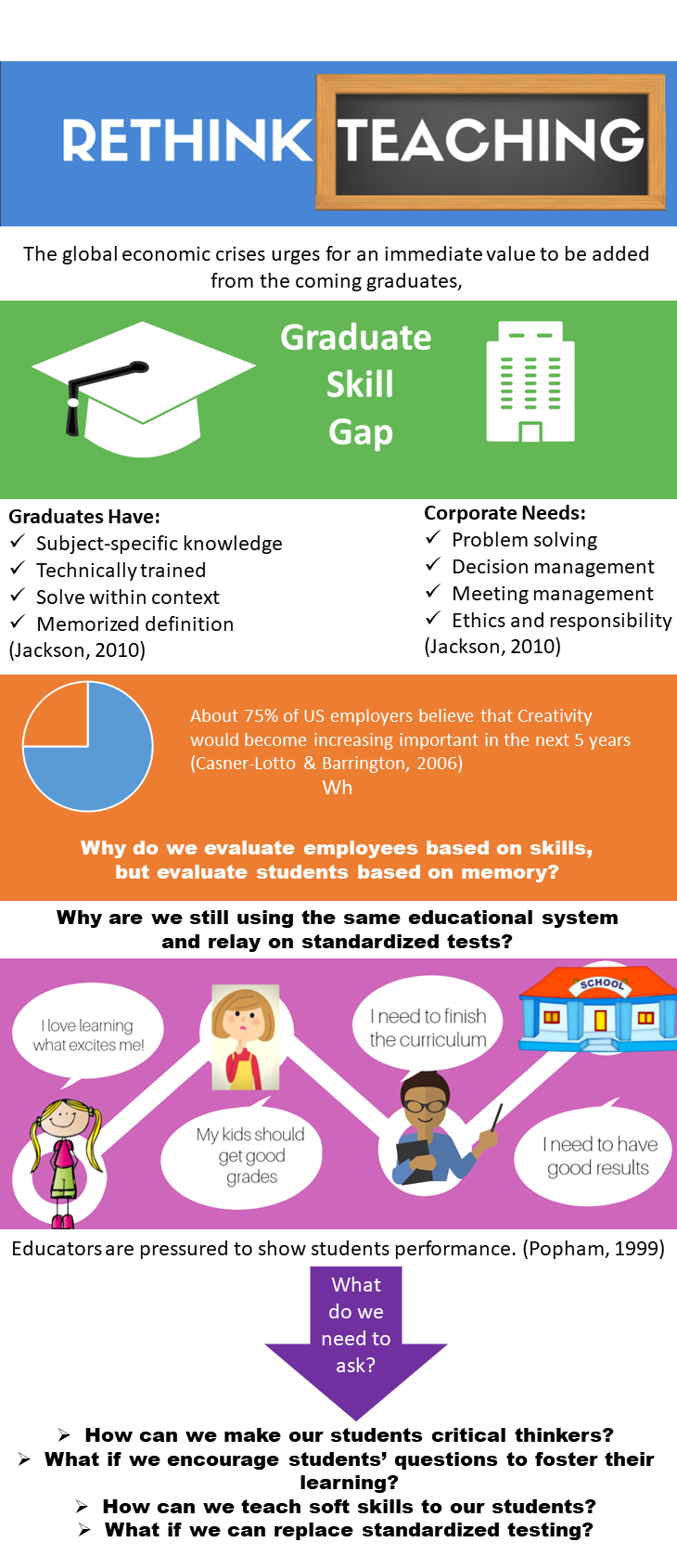
Rethinking Teaching Inforgraph

In the past few weeks I started thinking and researching on Teaching and how we could rethink it to make it cope with demands of this age. Only after chatting with my colleague, Kelvin, my approach to tackling the problem really changed. We were able to bounce off ideas and really look at the problem from completely different perspectives. It helped me realize the wickedness of the problem.

As a group, we defined our common ideas and decided to focus on a few key questions. We decided to focus on the problem from the end of mind. In other words: what does the market need? Be it corporate, entrepreneurship, government, etc. What are the key skills that we need the rising generation to have? The other key idea was to identify the core reasons behind the wickedness of rethinking education; why is it harder than it seams?

Below, I illustrate the problem in an infographic that pinpoints the core of our approach to rethink current teaching. It is made simple and short to keep the central goal highlighted.

infog

References:

Casner-Lotto, J., & Barrington, L. (2006). Are they really ready to work? Employers’ perspectives on the basic knowledge and
applied skills of new entrants to the 21st Century U.S. workforce. USA: The Conference Board, Inc., the Partnership for
21st Skills, Corporate Voices for Working Families, and the Society for Human Resource Management.

Jackson, D. (2010). An international profile of industry-relevant competencies and skill gaps in modern graduates. International Journal of Management Education8(3), 29-58.

Popham, W. J. (1999). Why standardized tests don’t measure educational quality. Educational leadership56, 8-16.